DISCLAIMER
This brief summarizes two rules adopted by the Florida State Board of Education on September 16, 2026. It is an independent analysis and does not constitute legal advice or an official interpretation of the rules.
The analysis is based on the rule text as noticed prior to adoption and on public reporting of the Board’s action. Provisions reported at adoption, final rule language, and effective dates should be confirmed against the rules as filed with the Department of State.
Executive Summary
On September 16, 2026, the Florida State Board of Education unanimously adopted two rules establishing statewide requirements for artificial intelligence (AI) in public education. The rules set different requirements for K–12 schools and Florida College System (FCS) institutions.
The Board amended Rule 6A-1.0957, F.A.C., requiring district school boards and charter school governing boards to adopt policies governing AI instructional tools by July 1, 2027. It also adopted Rule 6A-14.0719, F.A.C., requiring FCS institutions to establish policies addressing AI use in instruction, operations, and academic integrity.
The two rules take different approaches. The K–12 rule sets detailed, tool-level requirements, including parental notice and consent, comparable non-AI alternatives, student data protections, and restrictions on certain applications. The FCS rule provides a broader policy framework, requiring colleges to address six areas and establishing one specific restriction: students may not use AI on graded work unless the instructor expressly permits it.
For school districts, meeting the July 2027 deadline will require coordination across instructional technology, procurement, legal compliance, and parent communications. For colleges, the rule creates a statewide policy requirement while leaving institutions flexibility in how they design and implement their policies.
Several implementation questions remain, including the effective date of the FCS rule, coordination of requirements for dual enrollment students, and provisions reported at adoption that have not yet been confirmed in the final filed rule text.
Rulemaking Following the 2026 Legislative Session
The 2026 Legislative Session ended without legislation specifically governing AI in education. Four proposals addressing K–12 standards, AI instruction, postsecondary governance, and consumer protections did not pass, leaving the State Board of Education to act through administrative rulemaking.
The Florida Department of Education (FDOE) initiated K–12 rulemaking in June 2026, proposing to incorporate AI requirements into the existing internet safety rule, and held a rule development workshop on August 5. Industry representatives raised questions about scope. The Software and Information Industry Association (SIIA), for example, expressed concern that the proposed definition of AI could reach district-approved instructional technologies as well as general-purpose AI applications.
FCS rulemaking followed in August, when Commissioner Henry Mack approved the proposed rule for consideration at the September meeting. Together, the two rules establish AI policy requirements spanning voluntary prekindergarten (VPK) through the FCS. State universities are not covered.
Alongside the Board's action, Commissioner Mack directed FDOE to update the K–12 Computer Science standards and the Florida Digital Classrooms Plan. The Plan revisions will emphasize evidence of student learning and require districts to show how effectiveness informs technology procurement and renewal decisions, adding expectations beyond the AI rule itself.
K–12 Requirements: Rule 6A-1.0957, F.A.C.
The amended Internet Safety Policy rule requires each district school board and charter school governing board to adopt policies governing AI instructional tools by July 1, 2027. The rule applies to traditional public and charter schools but not to private schools.
Scope of the Rule
The rule defines an AI instructional tool as software using generative AI that is made available to students for instruction, tutoring, practice, feedback, or teacher-directed assignments. Systems that do not interact directly with students, including those used solely to analyze, classify, predict, or optimize decisions from existing data, fall outside this definition.
This distinction matters for districts using AI across multiple functions. Student-facing applications carry requirements that do not apply to administrative analytics or early warning systems. The prohibition on companion-style AI, however, extends to any form of AI.
Parental Notice and Consent
Districts must give parents plain-language information about each approved AI instructional tool, including its name, grade levels and subjects, how students will interact with it, and the process for objecting under s. 1006.28(2)(a), F.S.
When students interact directly with a tool, parents must opt their child in. Students without parental consent must receive a non-AI alternative that is substantively comparable in instructional quality and access. Districts will need to plan so that comparable learning opportunities are available regardless of a parent's decision.
Instructional Safeguards
District policies must address the following:
Additional review of tools used in VPK through grade 5 for developmental appropriateness and alignment with state standards.
Use of AI to supplement, not replace, teacher judgment and parents' rights to direct their children's education.
Accuracy, transparency, viewpoint neutrality, accessibility, and compliance with s. 1000.05, F.S.
Academic integrity, including plagiarism, permissible use, verification of student work, and demonstration of mastery without AI.
Training for teachers and administrators on AI risks, limitations, safety, and compliance.
Application to all AI instructional tools, whether or not they were adopted as instructional materials under Chapter 1006, F.S.
Evidence and Transparency
Districts must periodically review the effectiveness of approved tools, considering independent evidence or evidence aligned with Every Student Succeeds Act (ESSA) tiers. Vendors must disclose known limitations and available independent evaluations, although the absence of independent studies cannot by itself prevent approval.
Districts must also maintain a public list of approved tools and report to FDOE each tool's grade levels, subjects, frequency of use, and duration of student interaction. Reporting does not require student- or teacher-level data.
Student Data and Records
AI instructional tools must retain records of student interactions for at least 30 days to support parental access under FERPA and s. 1002.22, F.S. Vendors may not sell or monetize student data, use it for profiling, or use it to train commercial AI models, and districts must prioritize vendors that store and process data in the United States. Tools must also comply with existing requirements for online educational services under s. 1006.1494, F.S., and Rule 6A-1.09550, F.A.C.
Prohibited Uses
Districts may not deploy AI designed, marketed, or configured to meet students' social or emotional needs, simulate friendship or companionship, or use anthropomorphic features to sustain engagement. The rule also prohibits undisclosed behavioral monitoring, social scoring, and psychological profiling. Districts will need to evaluate each application's design features and intended uses, not only its instructional purpose.
Provisions Requiring Confirmation
FDOE's September 16 announcement and subsequent news coverage described additional requirements: supervision of student AI use, the ability for school personnel to immediately suspend or disable a tool without vendor assistance, and incident reporting when an AI agent compromises district data systems. These provisions do not appear in the noticed rule text reviewed for this brief and should be confirmed against the final filed rule.
Florida College System Requirements: Rule 6A-14.0719, F.A.C.
The new rule requires the boards of trustees of Florida's 28 public colleges to adopt one or more policies governing the use and limitations of AI, with the stated goals of educational quality, operational efficiency, and a safe learning environment. Rather than setting tool-level requirements, the rule identifies six areas institutional policies must address.
Legal compliance. Policies must address applicable state and federal privacy and intellectual property law, including FERPA and the Copyright Act of 1976.
Parental notice for minors. Colleges must notify parents of enrolled minors when their child will directly use an AI instructional tool in a course or program. Unlike the K–12 rule, this is notice only, with no opt-in or non-AI alternative.
Academic integrity. AI requirements must be integrated into existing integrity, assignment, and grading policies. Students may not use AI on graded work unless the instructor explicitly permits it, which will require consistent communication across policies, syllabi, and faculty guidance.
Approved tools and uses. Institutions must identify approved AI instructional and business tools and their permitted uses, extending the rule beyond the classroom to institutional operations.
Applicability. Policies must apply to students, faculty, staff, administrators, and guests.
AI literacy. Colleges must adopt a definition or framework for AI literacy that addresses its relevance to students' education and careers. The U.S. Department of Labor's AI Literacy Framework (TEN 07-25) is identified as an optional reference.
Institutions must also incorporate their AI policies into manuals, handbooks, forms, and other documents for students, employees, contractors, and guests.
Additional Distinctions
The FCS rule treats companion-style AI differently than the K–12 rule. Rather than prohibiting these applications outright, it excludes tools designed to meet social needs, simulate companionship, or use anthropomorphic engagement features from the definition of an AI instructional tool.
At adoption, the FCS rule did not specify a compliance deadline. Institutions should confirm the effective date and monitor guidance from the Division of Florida Colleges.
Comparing the Two Rules
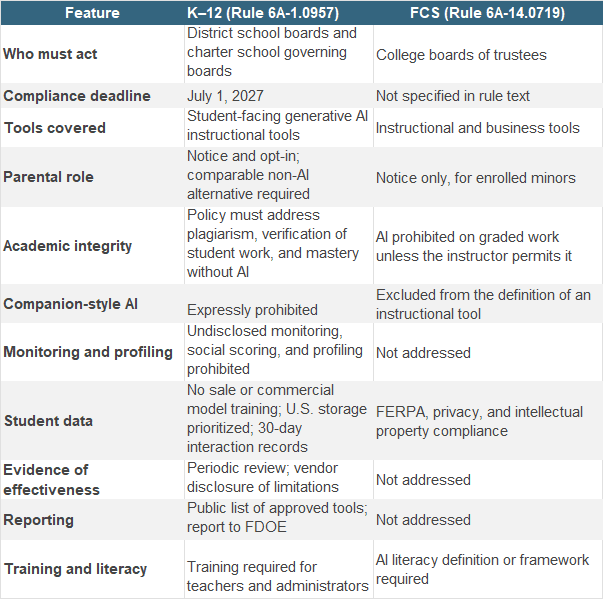
The most significant differences concern the scope of covered tools, parental involvement, academic integrity, and institutional discretion.
Table 1. Key Provisions of the K–12 and FCS AI Rules
Implementation Considerations
Although the requirements differ, both sectors will need to assess current AI use, review institutional policies, and establish processes for ongoing oversight.
Inventory existing AI tools. Identify AI applications used across instruction and operations, distinguishing student-facing generative tools, teacher-only applications, analytics and prediction systems, and AI features embedded in existing platforms. This determines which applications fall within the rules and where policies, vendor information, or safeguards are needed.
Plan for comparable non-AI alternatives. Districts will need to ensure that students without parental authorization can access comparable instruction, practice, and feedback. This is especially challenging for adaptive and tutoring platforms, so alternatives should be considered during tool approval rather than after implementation.
Review vendor agreements. Existing contracts and upcoming renewals should address student data use, restrictions on commercial model training, data storage and processing, interaction record retention, parental access, vendor disclosures, and reporting. Reviews should also account for any operational requirements confirmed in the final rule, including the reported ability to immediately disable a tool.
Establish parent communication and consent processes. Districts need coordinated processes to notify parents, document consent, respond to objections, and keep tool information current. Districts should confirm whether their student information and communication systems can support tool-specific consent and the documentation needed for compliance.
Update college policies and course materials. FCS institutions should align academic integrity policies, faculty guidance, and syllabus templates with the graded-work restriction, identify approved instructional and business tools, and define an approach to AI literacy. Because the rule applies to the whole college community, implementation should involve academic affairs, information technology, student services, and human resources.
Address dual enrollment. A high school student may be subject to parental opt-in in a K–12 course but only parental notification in a college course. Districts and colleges should review dual enrollment agreements to clarify which requirements apply, particularly for college courses delivered on high school campuses, including parent communication, approved tools, interaction records, and personnel responsibilities.
Coordinate technology evaluation. The K–12 rule's periodic effectiveness review aligns with planned revisions to the Digital Classrooms Plan. A common approach to evidence review, procurement, and renewal can support compliance while strengthening the link between technology investments and student outcomes.
Outstanding Questions and Next Steps
Final Rule Text and Timelines
The final filed rules should be reviewed to confirm provisions reported at adoption that were not in the noticed text. The FCS rule does not specify a compliance deadline, and the timing and format of K–12 reporting to FDOE have not been announced. Further guidance from FDOE and the Division of Florida Colleges may clarify these points.
Scope and Application
The K–12 rule does not define a "substantively comparable" non-AI alternative, which will matter most for adaptive learning and tutoring tools without a ready non-AI equivalent. Questions also remain about AI features embedded in learning management systems, productivity applications, and assessment platforms.
Additional State Action
Revisions to the Digital Classrooms Plan and K–12 Computer Science standards may add expectations for technology evaluation, procurement, and AI instruction. The State University System remains outside both rules, and the 2027 Legislative Session may bring proposals that build on or change the requirements established through rulemaking.
Conclusion
Florida's September 16 action establishes the state's first binding requirements for AI governance in K–12 public schools and FCS institutions. The K–12 rule sets detailed requirements for instructional tools, parental involvement, student data protection, and evaluation, with policies due by July 1, 2027. The FCS rule establishes a broader framework covering instructional and operational AI, academic integrity, and AI literacy.
For districts and colleges, implementation will require more than adopting a standalone AI policy. The new requirements intersect with instructional practice, procurement, vendor agreements, student protections, and governance. Starting with an inventory of current AI applications and a review of existing policies will help institutions identify gaps, set priorities, and prepare for additional guidance or legislative action.
Sources
Rule 6A-1.0957, F.A.C., Internet Safety Policy, amendment text as noticed prior to adoption.
Rule 6A-14.0719, F.A.C., Artificial Intelligence (A.I.) Policies in Florida College System Institutions, rule text as noticed prior to adoption.
Florida Department of Education, press release on State Board adoption of AI rules, September 16, 2026.
News Service of Florida, "State board approves AI guidelines for K-12 schools, colleges," September 17, 2026.
WFLA, "Florida education board approves AI rules for colleges," September 16, 2026.
CBS Miami / News Service of Florida, coverage of proposed FCS AI rule, August 26, 2026.
Software and Information Industry Association, comments on proposed Rule 6A-1.0957 amendment, August 2026.
About TSG ADVISORS – EDUCATION TSG Advisors – Education seeks to serve as a leading partner in education and workforce consulting by bridging policy development with strategic implementation. We work alongside public institutions, nonprofits, government agencies, philanthropy, and private partners to develop practical strategies that support effective programs, strengthen alignment between education and workforce systems, and advance high-impact practices across the education landscape. Grounded in deep experience across the education sector, the TSG Advisors team brings subject matter expertise and a shared commitment to improving outcomes through collaborative, evidence-informed approaches.
For questions about this analysis or assistance with AI policy development, vendor review, or dual enrollment coordination, please reach out to our Education practice.
• Website: www.tsgadvisors.com/education/ • Email: education@tsgadvisors.com |