Which Florida Credentials May Qualify for Workforce Pell? A Data-Informed Estimate of Workforce Pell-Eligible Programs in Florida
Prepared by:
Carrie E. Henderson, Ph.D.
TSG Advisors – Education
henderson@tsgadvisors.com
Date:
April 2, 2026

Executive Summary
The One Big Beautiful Bill Act (OBBBA), enacted in summer 2025, expanded Pell Grant eligibility to short-term, career-focused training programs through a new provision commonly referred to as “Short-Term Pell” or “Workforce Pell.” As the U.S. Department of Education moves toward finalizing implementing regulations—with proposed rules released in March 2026—Florida institutions must begin assessing which of their programs may qualify under the new framework.
While the State of Florida has not yet released official guidance on its certification process, this white paper provides Florida school district technical colleges and Florida College System institutions with a data-informed proxy assessment. Using 2024 CTE audit data cross-referenced against the 2026-27 Master Credentials List (MCL), this analysis evaluates 191 in-scope programs across four key eligibility dimensions.

Among the 191 programs meeting the Workforce Pell length requirement, 60 meet all screening criteria, 17 meet wage and demand thresholds with partial outcome performance, and 83 do not currently meet outcome benchmarks, indicating that roughly 40 percent of eligible-length programs show strong or moderate alignment with proposed Workforce Pell requirements.
Background: The One Big Beautiful Bill Act
Congress enacted H.R. 1, the One Big Beautiful Bill Act, in summer 2025. Among its key workforce provisions, the legislation expanded Pell Grant eligibility to students enrolled in short-term, career-focused training programs—a long-sought reform known as “Short-Term Pell” or “Workforce Pell.” The expansion reflects growing bipartisan recognition that the traditional two- and four-year college framework does not serve all learners, and that shorter credential programs can deliver meaningful economic returns.
The U.S. Department of Education released proposed implementing regulations in March 2026 and is expected to finalize them later in spring 2026. These regulations provide significant flexibility to states in defining eligible programs, making state-level decision-making a critical factor in implementation.
Federal Eligibility Requirements
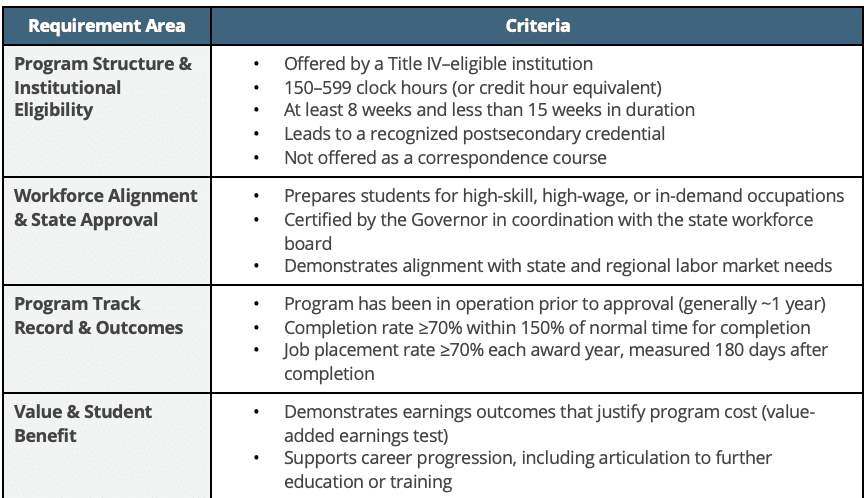
Under the proposed regulations, programs must satisfy requirements across four primary areas:
Florida Implementation Context
Under the proposed Workforce Pell regulations, program eligibility is not determined solely at the institutional or federal level—states play a central gatekeeping role. Governors, or their designated state agencies, are responsible for certifying which short-term programs qualify by confirming that they prepare students for high-skill, high-wage, or in-demand occupations. This certification process is expected to occur in coordination with state workforce development boards, relying on labor market data, employer input, and existing workforce priorities.
While specific details on how Florida will select eligible programs have not yet been released, TSG Advisors anticipated that the state will identify qualifying short-term programs by cross-referencing the Master Credentials List (MCL) with CTE audit data and statewide curriculum frameworks. Many of the credentials on the MCL are components of broader stacked or articulated pathways that lead to higher-level certificates or degrees, which may strengthen their case for certification.
Methodology
This analysis was conducted in two stages, designed to identify programs most likely to meet federal Workforce Pell criteria based on currently available data.
Stage 1: Program Length Screening
The initial stage screened all Florida short-term programs against the proposed federal program length requirement of 150–599 clock hours (or credit hour equivalent) and a duration of at least 8 but fewer than 15 weeks. The findings from this screening are summarized below:
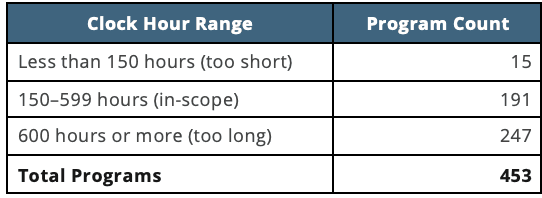
Of the 453 programs reviewed, 191 fell within the 150–599 clock hour range and were advanced to Stage 2. The majority of programs (247) exceeded the 599-hour ceiling and are therefore ineligible for Workforce Pell under the proposed regulations, regardless of other factors. A small number (15) fell below the 150-hour floor.
Stage 2: Multi-Criteria Eligibility Assessment
The 191 in-scope programs were evaluated against four criteria derived from the proposed federal regulations and the 2026–27 Master Credentials List. Each criterion and its data source are described in detail below.
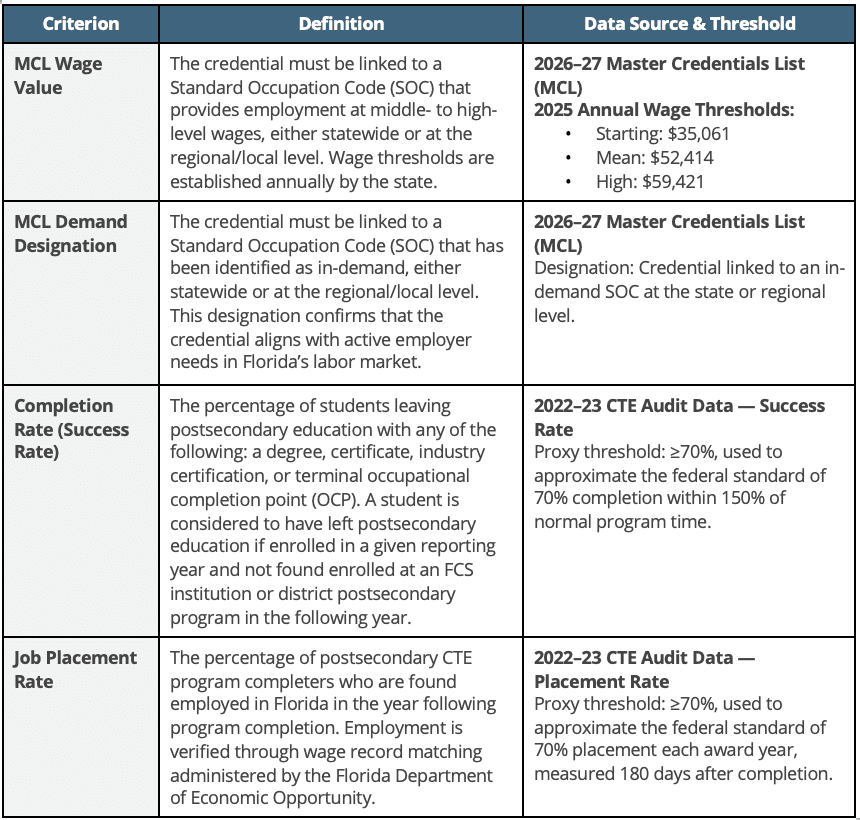
The completion and placement data in this analysis are drawn from 2022–23 CTE audit records, the most recent cohort data available at the time of writing. These figures serve as a proxy for the performance thresholds established in the proposed federal regulations and should be interpreted accordingly. Programs for which outcome data were not yet available (designated “nd”) are treated as indeterminate and identified as pending. Programs removed from the 2026–27 MCL are flagged separately and excluded from all eligibility tier counts.
Findings
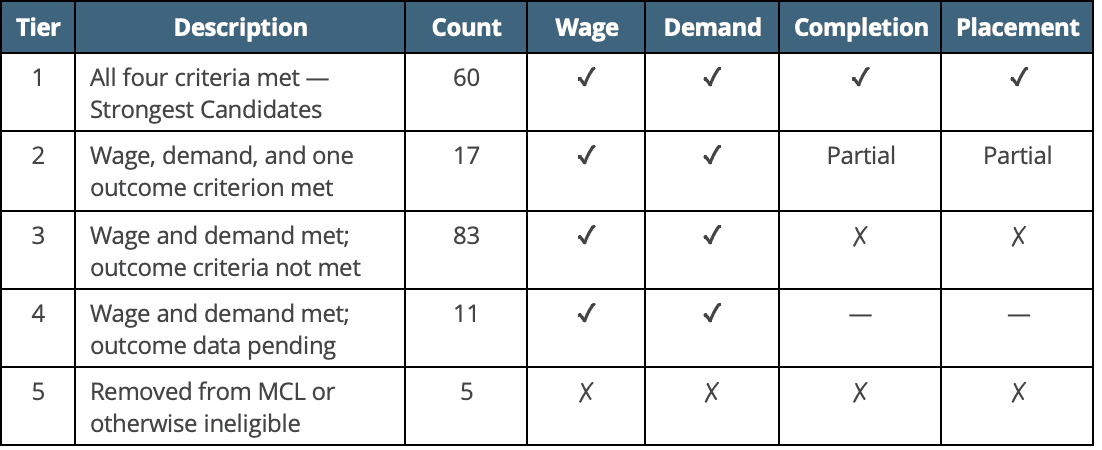
The 191 in-scope programs were grouped into five outcome tiers based on how many eligibility criteria they satisfied.
Tier 1: Strongest Candidates (60 Programs)
A total of 60 programs satisfied all four criteria assessed in this analysis. These programs have demonstrated alignment with state labor market priorities through their MCL designation, and have historical outcome data showing both adequate completion and job placement rates. Spanning career clusters from Health Science and Information Technology to Transportation & Logistics and Manufacturing, this cohort represents a broad cross-section of Florida’s workforce training landscape.
Programs in this tier include high-demand health credentials such as Nursing, Radiography, Radiation Therapy, and Cardiovascular Technology; public safety programs including Correctional Officer, Correctional Probation Officer, and FBRTP Law Enforcement Basic Training; and technical programs such as Database Technology, Network Systems Technology, CNC Composite Fabricator/Programmer, and Computer Programming and Analysis.
Tier 2: Partial Outcome Criteria (17 Programs)
Twelve programs met both the wage and demand thresholds on the MCL but satisfied only one of the two outcome performance criteria. The majority of these programs met the completion rate threshold but not the job placement threshold. This tier includes programs across Health Science (Mental Health Technician, Diagnostic Medical Sonography Technology), Information Technology (Computer Information Technology, Technology Project Management), and Manufacturing (Lean Manufacturing). These programs may be eligible pending improvement in the unmet outcome area, or may qualify if the Governor exercises available flexibility in weighting criteria.
Tier 3: Labor Market Criteria Met; Outcomes Below Threshold (83 Programs)
The largest category—83 programs—passed both the wage and demand filters on the MCL but did not meet either the completion or placement rate thresholds based on available 2024 CTE audit data. Many of these programs are in areas with clear labor market demand, including Information Technology, Manufacturing, Transportation & Logistics, and Hospitality & Tourism. Institutions offering these programs should prioritize improvements to program completion support and post-program employment tracking in preparation for future certification cycles.
Tier 4: Outcome Data Pending (11 Programs)
Eleven programs passed both MCL labor market criteria (wage and demand) but lacked sufficient outcome data to assess completion and placement rates at the time of this analysis. These are primarily advanced technical certificates (ATCs) and represent near-term opportunities for Workforce Pell eligibility once outcome data are collected and reported. Institutions should prioritize data collection for these programs.
Tier 5: Removed from MCL or Otherwise Ineligible (5 Programs)
Four programs were removed from the 2026–27 Master Credentials List. Their removal suggests they no longer meet state-level workforce priority thresholds and, therefore, are unlikely to qualify for Workforce Pell certification under any scenario. One additional program failed both labor market criteria and outcome metrics.
Looking Ahead
The proposed Workforce Pell framework creates a meaningful opportunity to expand access to short-term credentials aligned with high-demand occupations. Based on currently available data, approximately 40 percent of in-scope Florida programs demonstrate strong or moderate alignment with the proposed eligibility criteria, suggesting the state is well positioned to benefit from the policy change.
The findings also indicate that many programs meet labor market demand thresholds but may need to strengthen completion and employment outcomes to qualify. As federal regulations are finalized and state guidance is released, institutions may wish to review program design, employer partnerships, and outcome tracking practices to ensure readiness.
Overall, Workforce Pell has the potential to strengthen stackable credential pathways that support both immediate employment and continued postsecondary attainment.