Executive Summary
In April 2026, before the state had issued guidance, TSG Advisors published a data-informed estimate projecting which Florida programs might qualify for Workforce Pell once the short-term Pell provision of the One Big Beautiful Bill Act (OBBBA) took effect. That analysis was necessarily a predictive exercise, built from the 2026–27 Master Credentials List (MCL) and CTE audit data as proxies for eligibility criteria that had not yet been defined.
Florida has now released official guidance, a two-stage approval process, and a published 2025–26 Workforce Pell Program Inventory. This brief updates that earlier work with what is now known: the state’s actual methodology, the 31 programs approved for the initial inventory, and the concrete steps institutions must take to enroll students under Workforce Pell, which became available July 1, 2026.
Two findings stand out. First, Florida’s approved list is narrower and more targeted than a proxy analysis would suggest—31 programs in all. Second, the state narrowed the field from both directions, excluding college-credit programs above the career-certificate band and non-credit workforce training below it; every approved program is a clock-hour career certificate.
What We Now Know: Florida’s Methodology
Our earlier brief anticipated that Florida would identify eligible programs by cross-referencing the Master Credentials List with labor market data and existing curriculum frameworks. The published methodology confirms that core approach—and adds specific instruments the proxy did not capture.
Florida builds a state-approved program list using the MCL, the Targeted Occupations List (TOL), and statewide workforce priority occupations—including, notably, occupations recognized under the Florida Hometown Heroes Program (s. 420.5096, F.S.). The guidance also adds essential occupations as a demand category alongside high-skill, high-wage, and in-demand, and applies the state’s Framework of Quality together with explicit stackable and portable credential definitions to screen for credential value.
Critically, the guidance pairs these state frameworks with the hard federal performance bars now specified on the certification form:
• A program completion rate of at least 70 percent, measured within 150 percent of the normal time to completion.
• A job placement rate of at least 70 percent, measured 180 days after completion.
• A 12-month track record: the program must have met eligibility requirements for at least the 12 months preceding the Governor’s certification, effectively excluding brand-new programs from the first cycle.
• A value-added earnings test (34 CFR 690.95), weighing program cost against anticipated wages in the target occupation.
The Approved List: What Actually Qualified
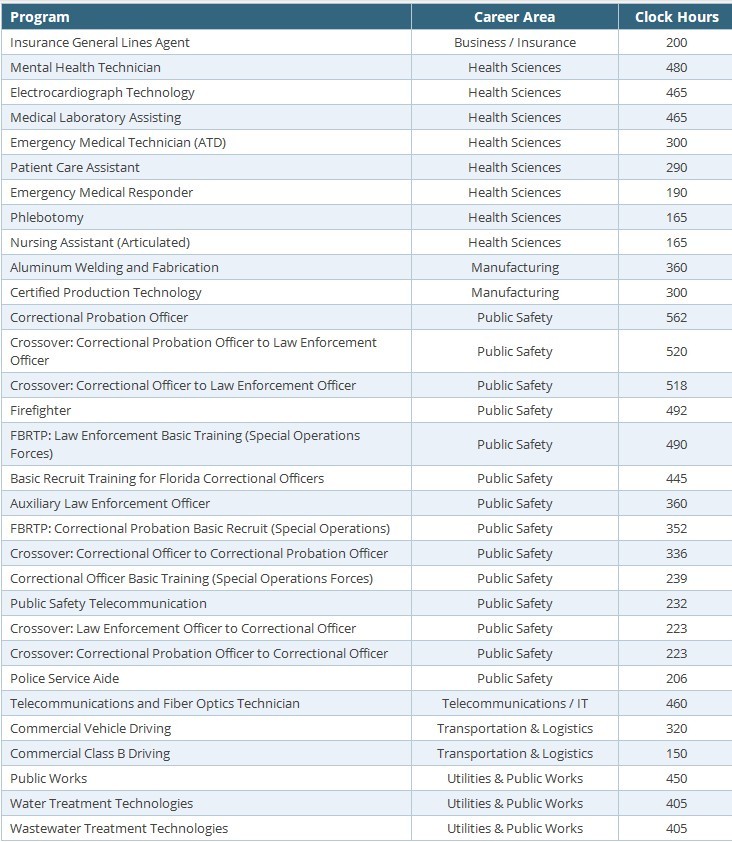
Florida’s initial inventory contains 31 programs, all clock-hour offerings ranging from 150 to 562 clock hours—inside the federal short-term window of 150 to 599 clock hours (or the credit-hour equivalent) and 8 to fewer than 15 weeks. Thirty are career certificates; one is an applied technology program (EMT).
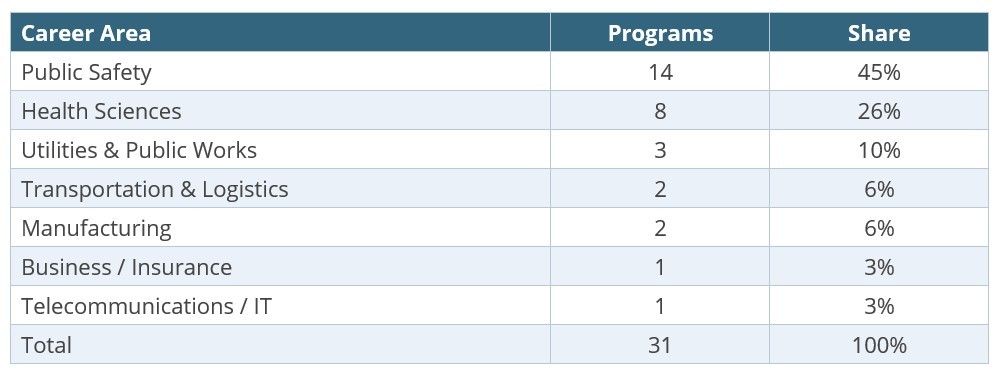
• Public safety dominates—14 of 31 programs (45 percent): law enforcement basic and crossover training, correctional and correctional probation officer programs, firefighter, police service aide, and public safety telecommunications. This concentration tracks directly with the Hometown Heroes and essential-occupation emphasis in the guidance.
• Short-term health—8 programs (26 percent): Phlebotomy, EMT, Emergency Medical Responder, Patient Care Assistant, Nursing Assistant, Electrocardiograph Technology, Medical Laboratory Assisting, and Mental Health Technician.
• The remaining nine programs (29 percent) span utilities and public works (water and wastewater treatment, public works), transportation (commercial driving), manufacturing (welding, certified production technology), telecommunications and fiber optics, and insurance licensing.

Non-credit workforce training was also excluded—as anticipated. At the other end of the spectrum, continuing workforce education and other non-credit training does not appear on the inventory. Non-credit offerings sit uneasily against the federal eligibility framework: they do not follow standardized program lengths, they are not measured in the same instructional units—clock or credit hours—the length test relies on, and they generally lack the completion, placement, and outcome data the state and federal thresholds require. Their exclusion is therefore unsurprising. It does, however, leave a real policy question open. Non-credit training is frequently a fast, employer-responsive on-ramp to high-value credentials, and its omission means a meaningful segment of Florida’s workforce-training capacity currently sits outside Workforce Pell. As the program matures, how—and whether—to bring non-credit pathways into an eligibility framework built around standardized instructional units is a question worth watching, and one where the state and institutions may need to develop new measurement approaches.
The complete 31-program approved inventory appears in the appendix at the end of this brief.
How Our Earlier Estimate Compared
The published list validates our directional call—MCL-anchored, labor-market-driven, and pathway-oriented—while sharpening it in ways a proxy could not. Two methodological differences explain most of the gap between our earlier estimate and the state’s 31 approved programs.
First, scope of eligible units. Our analysis applied a 30-to-1 clock-to-credit conversion to bring credit-hour programs into scope as credit-hour equivalents, consistent with the federal statute’s explicit allowance for either measure. Florida’s inventory, by contrast, is composed exclusively of clock-hour career certificates. Because the state declined to include credit-hour programs at all, an entire category our methodology treated as eligible was excluded from the final list.
Second, breadth of criteria. Our four screening filters—wage, demand, completion, and placement—captured the labor-market logic but not the full eligibility set. The state also requires stackable-and-portable credential design, articulation into a further certificate or degree, a 12-month operating history, and a value-added earnings test. These additional filters, particularly the outcome thresholds and the 12-month history, further narrow the field.
The lesson for institutions is straightforward: labor-market demand gets a program considered, but credential type, credential design, and demonstrated outcomes determine whether it qualifies.
What Colleges Need to Know
For institutions, Workforce Pell eligibility is a sequence, not a status. The six points below capture what matters most for the current cycle.
1. Check the inventory first—you confirm placement, you don’t nominate programs. The Governor, through FDOE, builds the approved list, identifying programs based on structure, credential alignment, demand, and outcome data. Your first action is to identify which of your programs already appear on the 2025–26 inventory.
2. For listed programs, complete institutional certification. You must verify—for your delivery specifically—program length and instructional hours, credential alignment, program offering history, and program outcomes. FDOE reviews and validates each certification before the program is federally active.
3. Then update your federal Title IV inventory (E-App). Certification alone does not turn on aid. The approved program must be added to your institution’s federal Title IV program inventory before enrolled students can receive Workforce Pell.
4. Stand up outcome reporting now. Completion and placement data must be reported to the U.S. Department of Education annually through the 2028–29 award year, after which only placement rates are required. Build the tracking infrastructure before you need it.
5. The eligible band is narrow: clock-hour career certificates only. The initial inventory admits neither college-credit programs (permitted federally as credit-hour equivalents, but excluded by state choice) nor non-credit workforce training. If your strategy assumed CCCs or noncredit training, reset expectations for this cycle—and watch whether future cycles open those doors.
6. Treat readiness as ongoing. Florida reviews the eligible-program list annually against labor-market demand, credential updates, and performance. Programs can be added or removed—the state must report any revocation within 15 calendar days—so certification is the start of a compliance relationship, not a one-time event.
Looking Ahead
Workforce Pell became available July 1, 2026, and Florida’s approach—building eligibility on the MCL, the Targeted Occupations List, and existing quality frameworks—positions the state to extend federal aid to short-term training with a clear line of sight to employment. The near-term opportunity is concentrated in the clock-hour career certificates already on the approved inventory, particularly in public safety and short-term health.
Two status notes bear watching. The program is live, but the federal State Workforce Pell Program Certification Form remains under OMB review (OMB No. 1845-NEW), so the certification instrument itself is not yet final even as the substantive requirements are settled. And because the exclusion of credit-hour and non-credit programs reflects state implementation choices rather than federal mandates, both categories are plausible candidates for inclusion in future annual cycles—an outcome institutions can help shape through engagement with FDOE.
FDOE has scheduled a Florida Workforce Pell Certification and State Validation webinar for July 8, 2026, which institutions should treat as the immediate next step for operational detail. TSG Advisors will continue to monitor the state’s implementation and is available to help institutions assess program placement, assemble certification evidence, and build the outcome-reporting infrastructure the program requires.
Appendix: 2025–26 Approved Program Inventory
The 31 programs below constitute Florida’s initial Workforce Pell approved inventory. All are clock-hour programs within the federal 150–599 hour window. Career-area groupings are TSG Advisors’, for readability.