Workforce Pell in Florida: Which Programs Are Positioned to Qualify—and How Many Students Could Benefit?
Executive Summary
Florida’s Workforce Pell landscape has expanded significantly since July.
The state’s original list included 31 programs, all clock-hour career certificates. The new list includes 107 distinct programs, driven by the addition of 76 short-term college credit programs. For Florida College System (FCS) institutions, this is a major shift: short-term credit programs that were absent in July are now positioned to participate.
The list is also much broader. What was concentrated in public safety and health now extends into manufacturing, arts and communications, hospitality, information technology, business, education, and other fields.
Using 2023–24 enrollment reported in Florida’s 2025 CTE Quality Audit, we estimate that programs on the list represent about 30,900 enrollments across 28 FCS institutions and 34 school districts.
The next question is how much of that opportunity translates into eligibility at the institutional level. Federal rules require each program at each institution to achieve a 70 percent completion rate and 70 percent verified job placement rate.
Because Florida does not yet publish the exact federal measures, we used the closest available data from the 2025 CTE Quality Audit to examine 589 individual program offerings. Thirty-four percent are at or above 70 percent on both available measures, while another 39 percent do not yet have enough data to assess both. Among offerings with sufficient data, completion is more often the determining factor than placement.
Based on current enrollment, Pell participation, program length, and available outcome data, we estimate Workforce Pell could provide $6.6 million to $14.0 million annually to approximately 3,300 to 5,400 Florida students, with about 94 percent supporting students at FCS institutions, compared to 6 percent supporting students at district technical colleges.
These estimates capture only students already in the pipeline. They do not account for additional enrollment that Pell availability could generate.
The bottom line: Florida has substantially expanded the reach of Workforce Pell, particularly for FCS institutions. The next phase is determining which individual program offerings meet federal requirements and how many students ultimately benefit. For the newly added CCCs, an additional implementation question remains: whether reported enrollment represents students actually pursuing the certificate for financial aid purposes or students associated with it through an embedded A.S. pathway.
Florida’s Workforce Pell Inventory Today
The biggest change since July is the addition of 76 short-term college credit programs, bringing Florida’s Workforce Pell inventory from 31 to 107 distinct programs. The original 31 clock-hour career certificates remain on the list.
All of the new programs are within the FCS; the school district inventory remains unchanged.
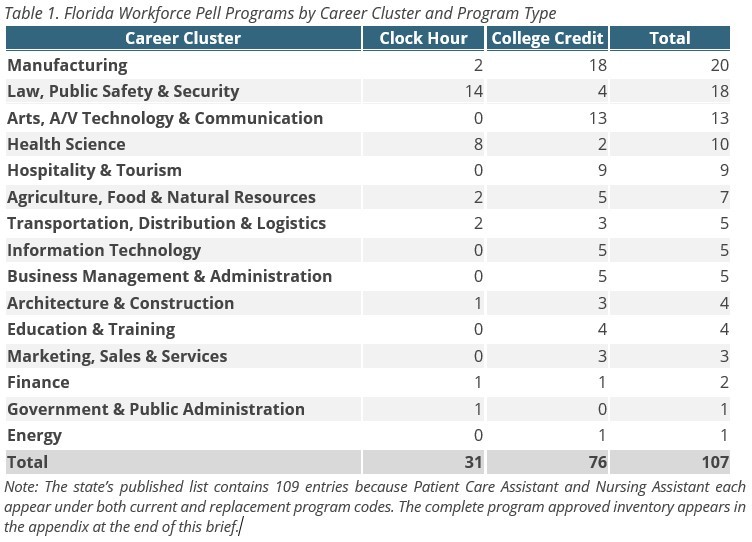
The expansion also broadens the types of programs represented. In July, 24 of 31 programs were in public safety or health. The new list adds substantial representation in manufacturing, arts and communications, hospitality, information technology, business, education, and other fields. Six career clusters that had no Workforce Pell programs in July now have 42.
Non-credit workforce training remains outside Workforce Pell.
How Many Local Programs Meet Eligibility Criteria?
The 107 programs on Florida’s inventory are only the starting point. Because federal eligibility is determined for each program at each institution, we first identified every FCS institution and school district offering each program, using 2023-24 enrollment from the 2025 CTE audit as a proxy.
That produced 589 individual program offerings statewide, representing about 30,900 enrollments in 2023–24. For example, a program offered by 20 institutions counts as 20 offerings because each institution must meet the federal requirements independently.
From there, we narrowed the pool based on outcomes.
Federal rules require each offering to have a 70 percent completion rate and a 70 percent verified job placement rate at 180 days post-completion, after at least 12 months of operation.
Florida does not yet publish those exact measures. We used the closest available measures in the 2025 CTE Quality Audit—a three-year success rate and FETPIP employment/continuing education within one year of completion—to understand how programs compare today.
These are not federal eligibility determinations. Florida’s current measures differ from what institutions will ultimately have to report, but they provide the best available picture of how programs are performing today.
Two findings stand out. Completion appears to be the bigger challenge. Among the 360 offerings with enough data to assess, 129 are below 70 percent on completion, compared with 67 on placement. Of those 129 offerings, 113 are programs added this cycle, nearly all of them college credit certificates.
We also do not know enough about a large share of programs. Nearly 40 percent of offerings lack enough data to assess both measures. That does not mean those programs are performing poorly, but institutions will ultimately need to document the completion and placement outcomes Workforce Pell requires.
How Many Students May Benefit from Workforce Pell?
To understand the potential reach of the expanded list, we used enrollment reported in Florida’s 2025 Postsecondary CTE Quality Audit to approximate how many students are already enrolled in these programs.
We estimate Workforce Pell could bring $6.6 million to $14.0 million annually to Florida, reaching approximately 3,300 to 5,400 students. Our middle estimate is about $10.5 million for 4,500 students.
Here is how we get there.
Start with the students already in these programs. The 201 program offerings that are at or above 70 percent on both available measures represented about 15,700 enrollments in 2023–24. That is our starting point.
Account for who is likely to qualify for Pell. Not every student will be financially eligible. Rather than applying one statewide assumption, we used each institution’s existing Pell participation rate. Across the 201 offerings, that reduces the potential pool from 15,700 enrollments to about 6,000 Pell-eligible students.
Estimate how many eligible students will actually receive Workforce Pell. Eligible students will still need to complete the FAFSA and take the steps necessary to receive aid. Because Workforce Pell is new, there is no experience yet to show what participation will look like. We model a range in which 55 to 90 percent of potentially eligible students receive an award. That produces an estimated 3,300 to 5,400 Workforce Pell recipients.
Account for the length of each program. Students will not generally receive the full $7,395 maximum Pell Grant. Workforce Pell awards are prorated based on program length. A 12-credit certificate, for example, represents half of a 24-credit academic year and would generate a correspondingly smaller award.
Putting those pieces together—current enrollment, Pell eligibility, student participation, and program length—produces an estimated $6.6 million to $14.0 million in annual Workforce Pell aid, with a middle estimate of approximately $10.5 million for 4,500 students.

Importantly, this estimate captures only the potential benefit to students already in the pipeline. It does not attempt to estimate additional students who may choose to enroll because Pell becomes available. As discussed later in this brief, reported CCC enrollment may include students primarily pursuing an embedded A.S. degree and should therefore be interpreted as a potential student pool. If Workforce Pell lowers the upfront cost of short-term programs and brings new students into them, the ultimate number of students served—and the federal aid flowing to Florida—could be higher.
The estimates above do not include the 229 program offerings with about 7,208 enrollments for which the available Florida data are not sufficient to assess both measures. If those offerings ultimately meet the federal requirements, the opportunity could be considerably larger. Under the moderate scenario, they would represent approximately 2,500 additional students and $5.3 million in additional Pell, increasing the statewide estimate from $10.5 million to about $15.8 million.
What Colleges Need to Know
Florida has substantially widened the Workforce Pell opportunity. Whether that translates into federal aid for students now depends largely on what happens at the institution and program level.
Do not confuse inclusion on the state list with eligibility. Florida’s inventory identifies programs that may participate, but each offering must ultimately satisfy federal requirements. Based on the closest available state measures, about one-third of offerings currently meet both 70 percent thresholds, while nearly 40 percent cannot yet be fully assessed.
For many institutions, the immediate challenge is measurement—not program expansion. The 229 offerings that cannot currently be assessed represent a potentially significant opportunity. Under our moderate scenario, if those offerings ultimately qualify, they could represent approximately 2,500 additional students and $5.3 million in additional Pell aid. Institutions need to know whether missing data reflect small cohorts, reporting limitations, insufficient program history, or actual performance.
FCS institutions should revisit their Workforce Pell strategy. The addition of 76 college credit programs substantially changes the opportunity from what institutions saw in July. But colleges should size that opportunity based on the performance of their individual offerings—not simply the number of programs appearing on the state list.
Title IV participation remains a prerequisite. State approval alone does not make federal student aid available. Institutions that do not currently participate in Title IV will need to address that threshold before students can receive Workforce Pell.
One More Question for Florida’s Colleges
There is one additional question that may become increasingly important as Workforce Pell implementation moves forward: Who is actually enrolled in the newly eligible College Credit Certificates?
Unlike most clock-hour career certificates, many CCCs are embedded within longer A.S. degree pathways. A student pursuing an A.S. degree may also appear in enrollment associated with one or more embedded certificates. This creates a distinction between students genuinely pursuing the CCC as their educational program and students associated with the CCC because of their enrollment in the broader A.S. pathway.
For Workforce Pell, that distinction matters. Program eligibility and student eligibility are separate questions. Even if a CCC appears on Florida’s approved inventory and the institution demonstrates the required completion and placement outcomes, the students counted in reported CCC enrollment are not necessarily the same students who will ultimately receive Workforce Pell. In particular, institutions will need to determine whether the CCC is the student’s actual program of study for financial aid purposes, rather than a credential embedded within a longer A.S. program the student is primarily pursuing. How institutions make and document that distinction could materially affect the number of students eligible to receive Workforce Pell.
The available CTE Quality Audit data do not allow us to make that distinction. Therefore, our estimates treat reported CCC enrollment as the potential student pool, which may overstate the number of students who will ultimately receive Workforce Pell if a substantial share of reported enrollment consists of students primarily pursuing an A.S. degree.
This raises an important implementation—and data—question for FCS institutions: Can colleges distinguish students who have formally declared and are pursuing the CCC from those who appear in the CCC because it is embedded within their A.S. pathway? Examining student program-of-study and financial aid records may be necessary to answer that question.
As implementation proceeds, resolving this issue will be important not only for determining individual student eligibility, but also for understanding the true size of Florida’s Workforce Pell opportunity and interpreting enrollment in the newly added college credit programs.

Appendix: Workforce Pell Program Inventory
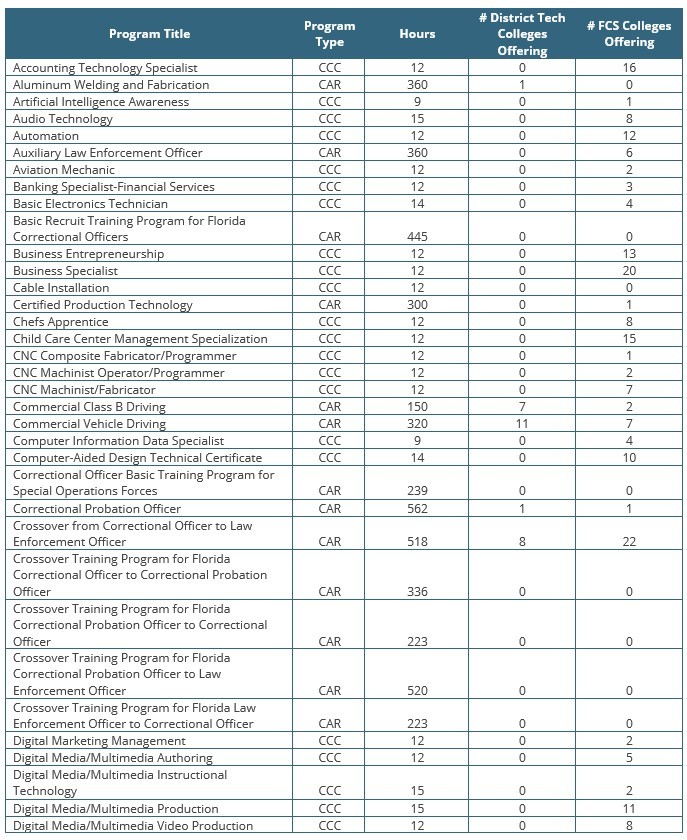
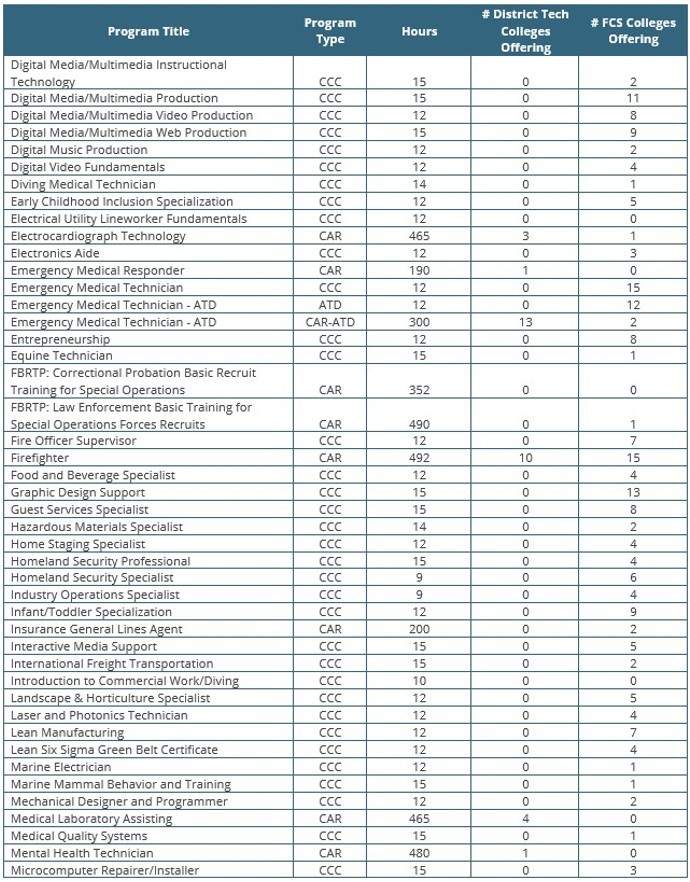
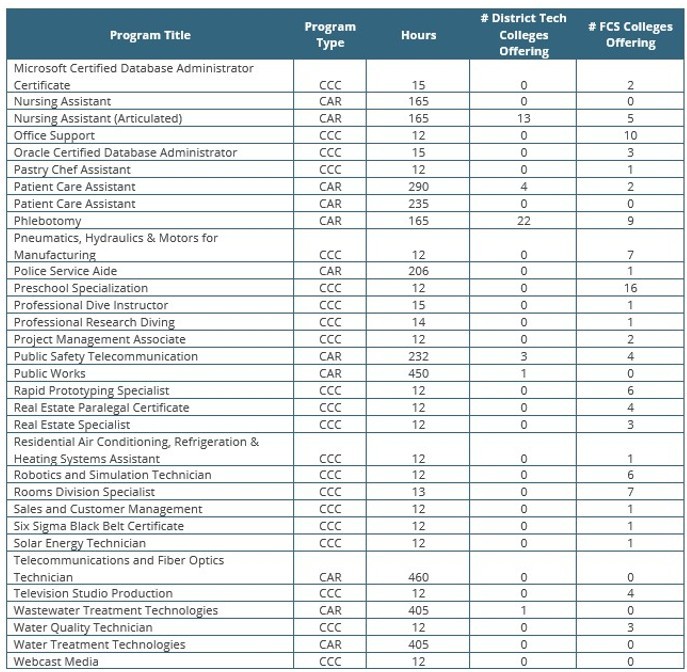
The programs below constitute Florida’s Workforce Pell-approved inventory as of September 2026. CCC denotes a College Credit Certificate (credit-hour program), while CAR denotes a Career Certificate (clock-hour program). ATD denotes an Applied Technology Diploma; CAR-ATD denotes an Applied Technology Diploma delivered as a clock-hour program. TSG Advisors added the estimated number of institutions offering each program, based on reported 2023–24 enrollment.